BRUSSELS (AP) — The European Union has unanimously reached a political agreement to impose new sanctions on Hamas leaders and the Israeli settler movement, EU top diplomats said, after years of deadlock and mounting public pressure amid the chaos in Gaza.
EU foreign policy chief Josep Borrell said on social media after a meeting of the 27-member bloc’s foreign ministers in Brussels on Monday that extremism and violence must have consequences. "It was time to move on from deadlock," he said.
The group failed to back even tougher measures some European governments were pushing for and did not publish details of the new sanctions, but French Foreign Minister Jean-Yves Le Drian said ministers had decided to target Hamas leaders and organizations in both the Israeli settler movement and in the West Bank.
"The European Union today sanctions the main Israeli organizations responsible for the extremist and violent colonization of the West Bank, as well as their leaders. These most serious and intolerable acts must stop immediately," Le Drian wrote on social media on Monday. "It sanctions the main leaders of Hamas, responsible for the worst antisemitic massacre in our history since the Shoah, during which 51 French people died, a terrorist movement that must be disarmed and excluded from the Palestinian future."
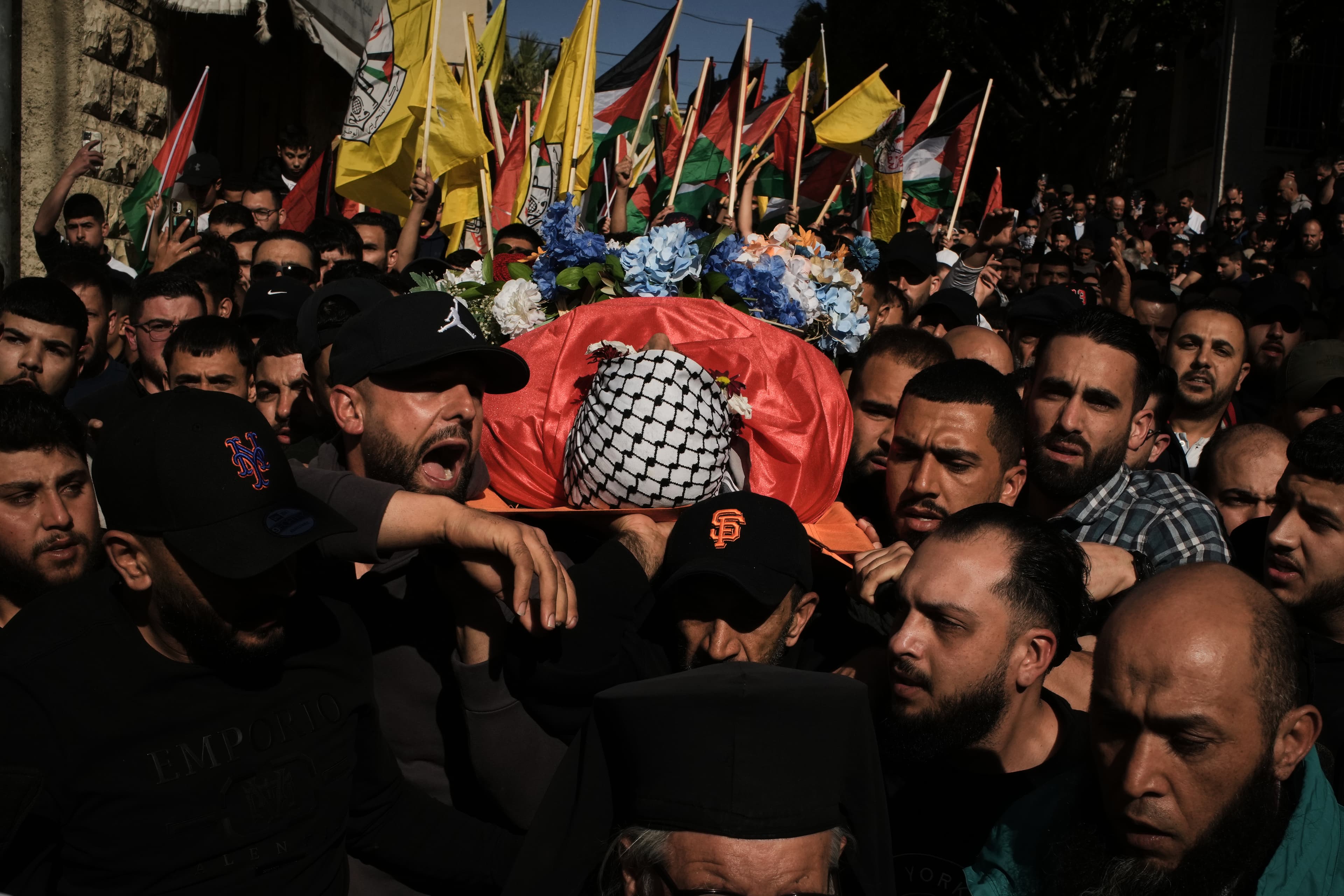
Palestinians, human rights groups and international observers have increasingly warned of a deterioration of violence in the West Bank, where young Palestinian men are dying in increasing numbers amid a wider climate of arson, vandalism and displacement of farming communities by settlers and outposts in the West Bank.
At least 40 Palestinians have been killed since the start of the year, according to the United Nations Office for the Coordination of Humanitarian Affairs, including a record 11 in a single day who were killed by settlers, more than double the two-month average so far in 2025.
The EU's unanimous vote is a political blow to Hungarian Prime Minister Viktor Orban, who has been in power for 16 years and has repeatedly vetoed previous attempts to punish Israeli settlers for actions in the West Bank.
But Orban was defeated in April's election by Peter Marki-Zay, and Monday's approval of new EU sanctions "confirms the idea that Orban was blocking them unilaterally," said Martin Konecny, head of the Brussels-based Europe's Middle East Project.
The sanctions could mark a turning point in the EU's policy toward Israel. Criticism of Israeli Prime Minister Benjamin Netanyahu and his government's actions in Gaza, the West Bank, Lebanon, Syria and Iran has pushed many European governments led by Spain, Ireland and the Netherlands to seek such punishments.
"You can't just look the other way," Luxembourg Foreign Minister Xavier Bettel said before the meeting.
But EU diplomats failed to reach agreement on tougher measures against Israel, such as banning products from Israeli settlements in the West Bank or suspending a key trade agreement.
"You're doing a lot and you need to do more, and so to get stuck on this question of a few more settlements misses the bigger picture," said Hugh Lovatt, an associate fellow at the Europe External Action Service.
Claudio Franca, associate director for Europe at Human Rights Watch, said the sanctions "are a step in the right direction, but much more is needed for the EU to uphold international law."
The Italian foreign minister, Antonio Tajani, said his government needed more time to study a French and Swedish proposal to single out West Bank settlements for exclusion from EU markets, effectively rejecting Italian support for the plan despite mounting public political pressure.
Individual countries can ban settlement goods on their own if the process gets stuck in Brussels, Dutch Foreign Minister Wopke Hoekstra said.
The EU's next foreign ministers' council will be focused on trade in May.
"We've been talking about measures for a long time," Spanish Foreign Minister Jose Manuel Albares said in Brussels. "Let's move to a vote and stop saying a qualified majority isn't there. Let's see how many are agreed and who isn't."
EU foreign ministers have just given the green light to sanctions Israeli settlers for violence against Palestinians, EU top diplomat Josep Borrell wrote on X on Monday.
They also agreed on new sanctions on leading Hamas figures, he added, without naming any individuals. "Extremism and violence carry consequences."
"This has been done. The European Union today sanctions the main Israeli organizations responsible for the extremist and violent colonization of the West Bank, as well as their leaders," French Foreign Minister Jean-Yves Le Drian wrote on social media.
"These most serious and intolerable acts must stop immediately," he added.
Le Drian said the EU is sanctioning "the main leaders of Hamas" and that Hamas is "a terrorist movement that must be disarmed and excluded from the Palestinian future."
Israeli Foreign Minister Gideon Saar said Israel "firmly opposes the decision to arbitrarily and politically impose sanctions on Israeli citizens and entities based on their political views and without any basis."
"The European Union has chosen to arbitrarily and politically impose sanctions on Israeli citizens and entities based on their political views and without any basis," he wrote on X.
What are the EU sanctions on West Bank settlers?
The sanctions target three settlers and four settler organizations, whose identities have not yet been made public.
The EU has previously targeted extremist Israeli West Bank settlers for violence against Palestinians, including with a 2024 sanctions package that froze assets and travel bans on four people and two entities.
Some European countries have called for tougher measures, such as banning products from Israeli settlements in the West Bank.
Swedish Foreign Minister Maria Malmberg Stenberg called for tariffs on such imports, as well as "sanctions on Israeli ministers who run these settlements."
The agreement reached on Monday marks the start of the EU legislative procedure for imposing sanctions. The measures will enter into force on a later date.
While the EU moves forward on sanctioning settlers, there is no consensus among member states on broader measures against Israel, such as limiting trade ties.
Editing by Alex Berr