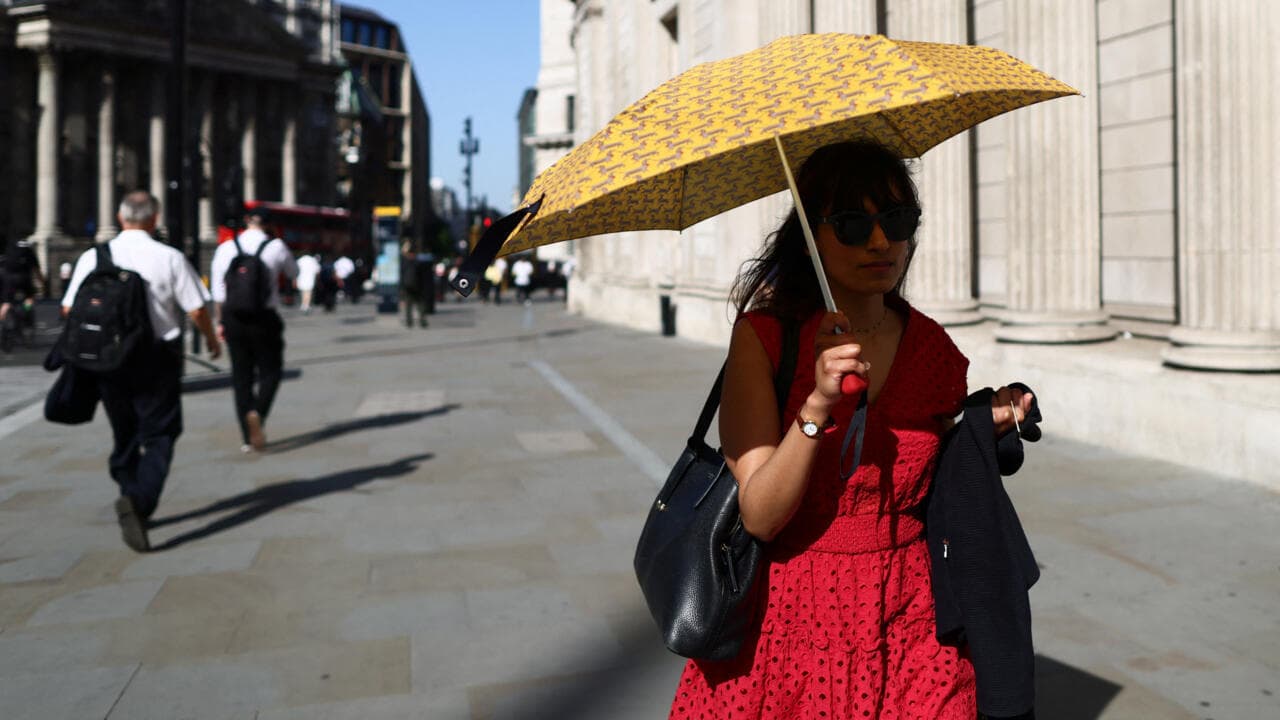
"Heat dome" causes unusually high temperatures in Europe, significantly exceeding seasonal norms. The UK and France have already set May records, while Spain and Italy face heat warnings and restrictions on outdoor work. Scientists say climate change is making such extreme heat events more frequent.
European meteorologists warned on Tuesday of exceptional heat as record-breaking temperatures, caused by a "heat dome", push the continent's temperatures well above seasonal norms. This wave followed a record-breaking Monday, with France recording record-breaking heat for May, according to its weather agency, while the UK also recorded unprecedented high temperatures.
Warm air from North Africa, known as the so-called "heat dome", is the cause of the high temperatures that are usually not seen until late summer under a high-pressure system in western Europe.
Parts of Italy have imposed restrictions on outdoor work, beaches in south-west France are unusually crowded for this time of year, and farmers have reported accelerated harvests as temperatures soar above 30 degrees across the region.
Scientists say that human-induced climate change is intensifying such extremes, with Europe warming faster than the global average and heatwaves becoming more frequent and severe, breaking temperature records more often.
In Spain, temperatures are expected to reach 38 degrees by the end of the week, while parts of Italy have imposed restrictions on outdoor work.
In the UK, the Met Office said Monday was a record-breaking May day, with temperatures reaching 34.8 degrees at Kew Gardens in south London - more than two degrees above the previous record.
"This heatwave would be unusual in the UK even in mid-summer, let alone in May", it said on X.
"The weather here feels like a mini version of hell. It's so hot. It's so hot," said 10-year-old Lisa Nizar during a visit to London, where temperatures are usually around 17 degrees or 18 degrees at this time of year.
The Met Office predicted a drop by the end of the week.
Lindy Brand-Dalouse, a 66-year-old Australian who has lived in London for 12 years, said: "It's warm, but it's climate change, isn't it? So I suppose we have to get used to it."
Scientists say that human-induced climate change is making extreme weather, such as heatwaves, droughts, and floods, more intense, with temperature records being broken more often.
Meteorologist Greg Dehurt said extreme temperature rises are "a good indicator of climate change action" and are more likely to become "the new normal".
Last week, climate advisors warned the British government that the country "has been built for a climate that no longer exists" and urged it to adapt infrastructure such as schools and hospitals for a warming planet.
In 2022, UK temperatures rose above 40 degrees for the first time since records began.
Record May temperatures of 28.8 degrees were recorded at two Irish weather stations: Kearns in the southwest and Clonmel in the south, according to Met Eireann data.
Near Edinburgh, a grass fire broke out on Arthur's Seat hill, sending smoke over the Scottish city where temperatures reached 25 degrees, firefighters and BBC reported.
Across the Channel, the weather agency Meteo-France said Monday was the hottest day ever recorded for May since records began.
It said temperatures of between 33 and 36 degrees were expected in regions, adding that this period was likely to continue until the end of the week.
French Prime Minister Sebastien Lecorneau will hold a meeting on Thursday with key ministers to discuss government preparations for the heat.
The capital, Paris, recorded its first temperature above 30 degrees for the year on Saturday, reaching 31.9 degrees.
On Sunday, a man died during a 10-kilometer run in Paris, civil defense services said, while another 10 were taken to hospital in critical condition in the Paris suburb of Mantes-la-Jolie.
On Saturdays, tennis fans at Roland Garros in Paris were fainting from the heat.
Restrictions on outdoor work have been imposed.
In Spain, the state weather agency (Aemet) warned of "unusually high temperatures at this time" continuing throughout the week, except on the Canary Islands off the northwest coast of Africa.
"Widespread tropical nights" are also expected in southwestern Spain from Wednesday, with temperatures peaking between 36 and 38 degrees on Wednesday and Thursday, it wrote on X.
Further east, the Lazio region in Italy, which includes Rome, approved rules on Monday that restrict work in "conditions of long exposure to the sun" from 12:30 pm to 4:00 pm.
These measures apply, for example, to farms, construction sites, and the logistics sector, and are in effect until September 15.
Last year, similar rules were introduced, but only from May 30.